
Car Problems Guide
Why Does My Car Clunk Over Bumps?
A clunking, knocking, or rattling sound when driving over bumps, rough pavement, or turning is one of the more common suspension and steering complaints. The sound alone doesn't identify the source — several different components can produce similar noises. Here's what's commonly involved.
Quick Answer
Clunking over bumps is most often caused by worn struts or shock absorbers, loose or worn sway bar end links, or worn ball joints. The clunk happens because a component that should be firmly connected has developed play — and the bump forces it to move. The specific cause requires inspection, since several different components can produce the same sound.
Sway Bar Links and Bushings
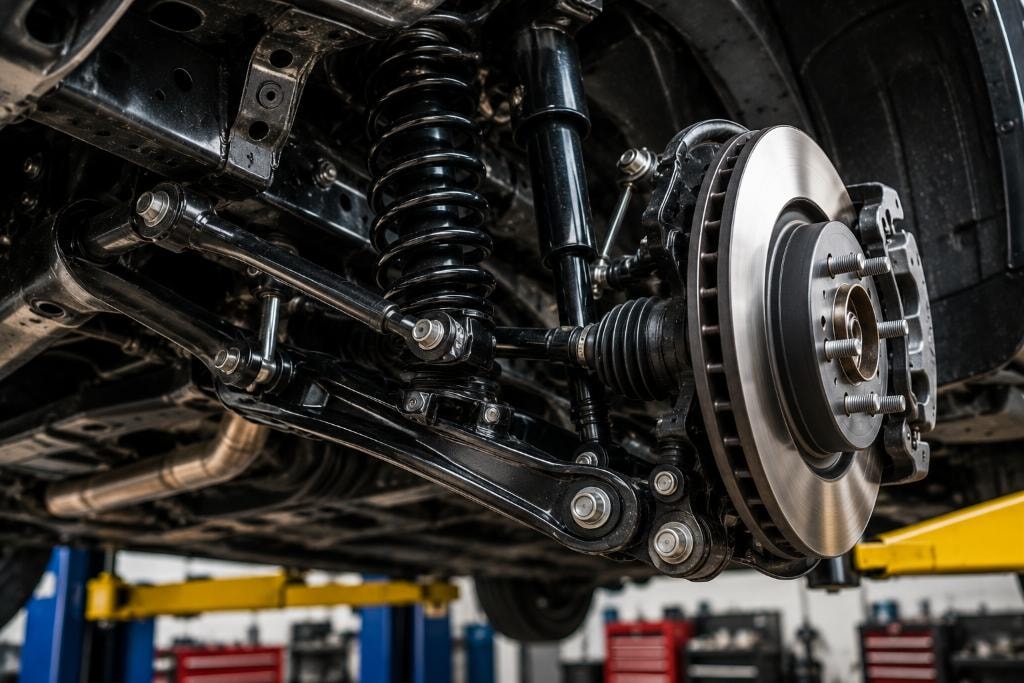
The sway bar (also called an anti-roll bar) connects the left and right sides of the suspension to reduce body lean in turns. Sway bar end links connect the bar to the suspension, and bushings cushion the bar's mounting points. Worn or broken sway bar links are one of the most common causes of clunking over bumps — they're relatively small components that can produce a surprisingly loud knock when they fail. Sway bar bushing wear can produce a similar sound.
Struts and Shock Absorbers
Struts and shock absorbers control how the suspension responds to road irregularities. A strut that's worn or has a damaged mount can produce clunking or knocking sounds, particularly over bumps. Strut mount bearings — which allow the strut to rotate during steering — can also wear and produce noise. Strut-related noise often changes when turning, which can help identify it.
Ball Joints
Ball joints connect the control arms to the steering knuckles and allow the suspension to move while the wheels turn. Worn ball joints can produce clunking sounds, particularly over bumps or when turning. Ball joint wear can also affect handling and tire wear. Because ball joints are a structural component of the suspension, significant wear deserves prompt attention.
Control Arm Bushings
Control arms connect the wheel hub to the vehicle frame and allow the suspension to move up and down. Rubber bushings at the control arm mounting points cushion this movement. As bushings wear, they allow more movement than intended, which can produce clunking or knocking sounds over bumps. Bushing wear can also affect alignment and handling.
Tie Rods
Tie rods connect the steering rack to the steering knuckles. Worn tie rod ends can produce clunking or looseness, particularly when turning or going over bumps. Tie rod wear can also affect steering precision and cause uneven tire wear.
Other Chassis Components
Other components that can produce clunking sounds include worn wheel bearings (which may produce a grinding or rumbling sound that changes with vehicle speed), loose heat shields, exhaust components that have shifted, or other hardware that's come loose. The location of the sound — front, rear, left, right — and when it occurs can help narrow down the likely area.
Clunking sounds are notoriously difficult to diagnose without a physical inspection. The same sound can come from several different components, and the component that's actually causing the noise isn't always the one that seems most obvious. A suspension inspection — which includes checking components for wear, looseness, and damage — is the right way to identify the source.
Reviewed by the Stop & Go Car Care automotive team.
Related Services
READY TO HAVE IT INSPECTED?
We offer a free suspension check at all three locations. Choose the one nearest you.